From the Agentic State to Planetary Governance?
Photo: Juho Länsiharju
The Agentic State is a vision paper that explores how Agentic AI systems will rewire the core functions of government — spanning public services, crisis management, governance, and procurement — and what technological, organisation and leadership changes are needed to enable this shift. The vision paper was launched at the Tallinn Digital Summit in October 2025 and it was presented at Miltton by one of the masterminds behind it, Luukas Ilves who is a former government CIO and undersecretary for digital transformation in Estonia.
Miltton invited four thinkers and four perspectives for a commentary round by Akseli Virtanen, Alku Sirén, Lauri Paloheimo and myself to explore the idea of the Agentic State. I am glad to share my written form of the commentary below.
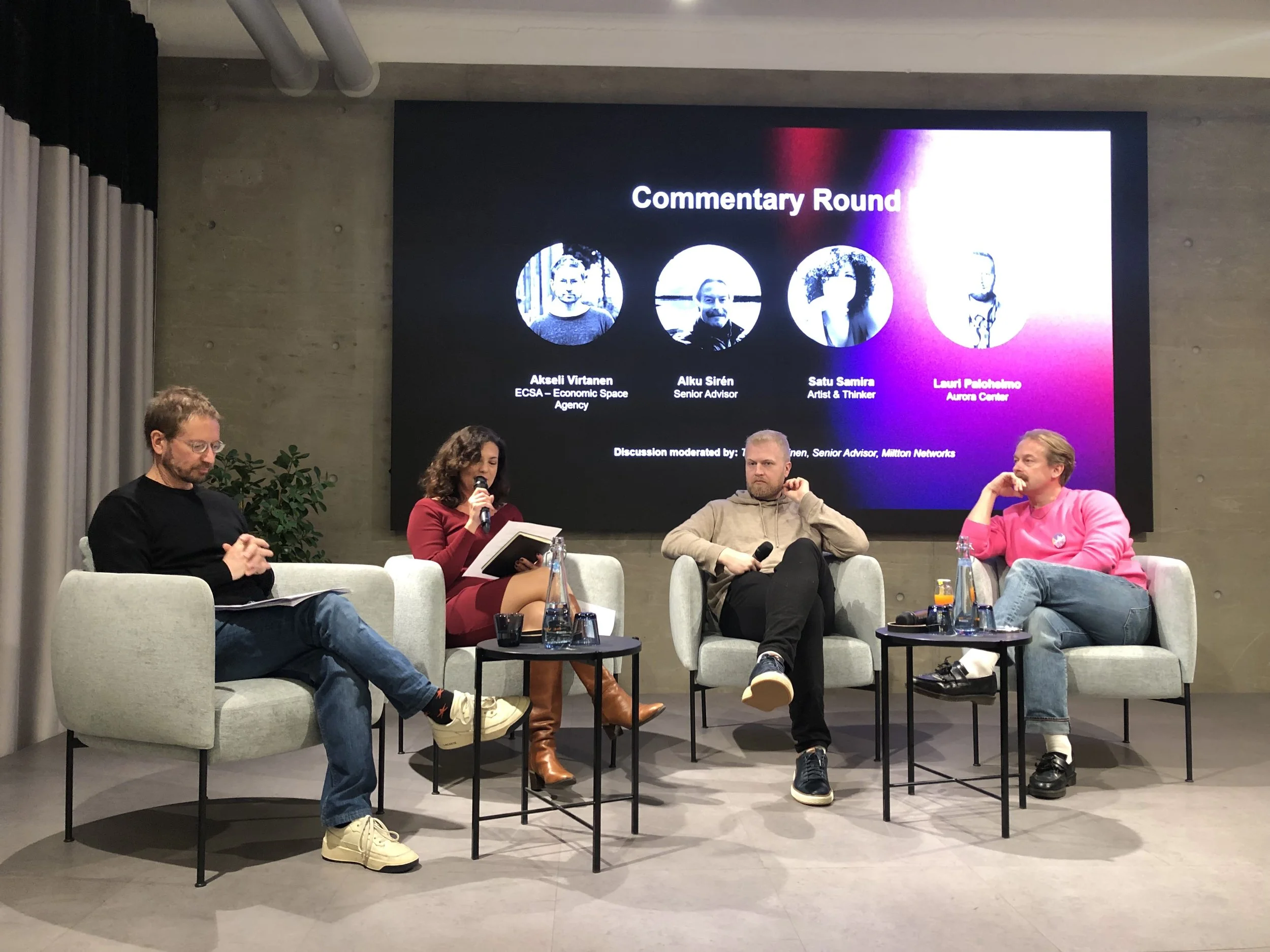
Akseli Virtanen, Satu Samira Hamed, Lauri Paloheimo and Alku Sirén sharing commentary to the Agentic State vision paper from four different perspectives.
Commentary by Satu Samira Hamed: the Planetary Governance Perspective
If I ask you what your vision of the world is — and whether this vision of the Agentic State represents that, what would you answer?
My vision of the world is Planetary.
My main question today is that is it possible, through the vision of the Agentic State, to build sustainable planetary well-being for both people and nature? That, in my view, is the most crucial question — or one of them — when we think about what is good and what is bad.
Over the past year, I have studied diplomacy at the United Nations Institute for Training and Research (UNITAR) in Geneva. During my studies, I explored the idea of planetary diplomacy, or so-called beyond state diplomacy. A diplomacy that does not focus only on nation-states.
That is why I find the idea of the Agentic State fascinating — perhaps as a first step towards something broader, more systemic and network-based. Beyond nation-states.
I am interested in whether the Agentic State model could allow us to build the future in a non-anthropocentric way — that is, not merely human-centered. Could we include in decision-making others besides humans: technology? AI agents? Animals? Nature? Who would negotiate and about whose rights? This more-than-human perspective was not present in the report, which to me shows that it is highly anthropocentric — meaning, not planetary.
In order to move towards the planetary, I believe it requires, from an administrative or bureaucratic perspective, Earth System Governance — that is, a planetary governance system. Planetary governance takes into account the planet’s ecosystems, biodiversity and global interdependencies.
The climate knows no borders, pandemics do not ask for permission and ecosystem collapse does not wait for political schedules. I would like to see this aspect included in the further development of the Agentic State vision.
We already have existing international agreements, but few of them cover our entire planet. That is why the idea of planetary governance has emerged. At its core lies wellbeing. If we are creating anything into this world, I believe, it must be founded on wellbeing as its core principle. The word “wellbeing” was not mentioned even once in the report. Planetary wellbeing means that human wellbeing is in reciprocal relationship with the wellbeing of our planet.
The Agentic State — A Step Towards Planetary Governance?
I do not believe that one or two Agentic States would be enough to enable planetary governance — rather, it might require that we globally shift towards a model of Agentic States.
An agentic polylateral model could be one approach. We already have bilateral relations (between two states) and multilateral ones (involving many states), but polylateralism would include nature, non-nation-states, non-state actors such as cities, companies, ngo's, civil society, nature, and more-than-human actors.
As I said earlier, I see the Agentic State model as one step — but not, in itself, sufficient for the transition towards a planetary future vision. I believe that the Agentic State model could perhaps set in motion a Global Agentic Planetary Institution or an institutional mechanism that coordinates a network of agentic planetary governance and its decisions — a highly complex system in which we use technology for the benefit of humankind, not against it. Humans alone are not capable of managing such complexit, but machines are.